EC312 CAN-to-AWS Solution
Product: InHand EC312 Edge Computing Gateway
Use Case: CAN-bus Data Acquisition & Forwarding to AWS IoT Core
1. Solution Overview
1.1 Background
With the rapid adoption of Industrial IoT (IIoT), Smart Factory, Smart Mobility and Smart Operations, a large amount of equipment in the field (engines, generators, vehicles, sensors, controllers) communicates over the CAN bus (Controller Area Network). These data assets are usually trapped on the local bus and difficult to expose to upper-layer cloud applications. Traditional gateways often fail in field conditions because they cannot decode CAN frames natively, lack edge-side scripting, or cannot connect securely to public clouds such as AWS.
This solution uses the InHand EC312 edge computing gateway as an "on-board computer" that:
- Reads raw CAN frames from the local bus,
- Decodes and normalizes the data with a Python application,
- Buffers the data through an internal MQTT message bus and the built-in Device Supervisor (DSA) virtual controller,
- And finally publishes the data securely (TLS/X.509) to AWS IoT Core for storage, analytics, and visualization.
1.2 Objectives
- Acquire CAN-bus data from field equipment in real time
- Decode, structure and standardize CAN frames at the edge
- Push data to AWS IoT Core with minimum latency and minimum cellular traffic
- Enable remote configuration, remote diagnosis and remote upgrade of the edge gateway
- Provide a flexible Python runtime for customer-specific protocol parsing
- Deliver a secure, reliable, low-OPEX field deployment
1.3 Application Scenarios
The EC312 + DSA + AWS pattern fits any project where CAN-bus data must reach a public cloud:
- Commercial vehicle / fleet telematics — engine ECU, transmission, brakes, fuel system (J1939, OBD-II)
- Off-highway and construction machinery — excavators, loaders, cranes, agricultural tractors
- Power generation & gensets — diesel generator controllers with CAN/J1939 interface
- Industrial machinery — CNC, presses, compressors and pumps with CAN-based PLC drives
- EV charging & battery management — BMS, charger CAN reporting
- Marine & rail rolling-stock telemetry
- Aftermarket sensor integration — differential pressure, vibration, temperature sensors broadcasting on CAN
Reference field example (this manual): A Differential Pressure (DP) sensor broadcasts pressure and temperature on CAN ID
0x18FF0155. EC312 reads it throughcan2, converts to bar / °C, and forwards to AWS IoT.
2. Requirements Analysis
2.1 Field-side situation
| Item | Typical value |
|---|---|
| Device types | ECUs, sensors, controllers with CAN interface |
| Communication interface | CAN 2.0A/B, optional Modbus/Ethernet |
| Communication protocol | Raw CAN, J1939, OBD-II, vendor-specific |
| Deployment environment | Vehicle / outdoor / industrial cabinet |
| Power | DC 9–36 V (matches EC312 input range) |
| Connectivity | 4G/LTE cellular as primary, Ethernet as backup |
2.2 Core requirements
- Acquisition — read CAN frames in real time without losing messages.
- Edge processing — decode physical values at the edge (bar, °C, RPM…), filter noise, drop redundant frames.
- Network — 4G primary uplink, low traffic consumption, automatic re-dialing.
- Cloud integration — secure connection to AWS IoT Core, X.509 mutual TLS.
- Remote O&M — remote configuration, remote diagnosis, remote firmware upgrade via InHand Device Manager.
- Security — encrypted transport, certificate-based authentication, role-based local web access.
3. Overall Architecture
3.1 Logical architecture (four layers)
- Perception layer — CAN sensors, ECUs, controllers
- Edge layer — EC312 with Python application + Device Supervisor (virtual controller + AWS IoT north-bound)
- Network layer — 4G/LTE cellular (primary) and Ethernet (backup)
- Cloud / Application layer — AWS IoT Core, AWS Rules Engine, downstream services (Timestream / S3 / Lambda / QuickSight, etc.)
3.2 Solution topology
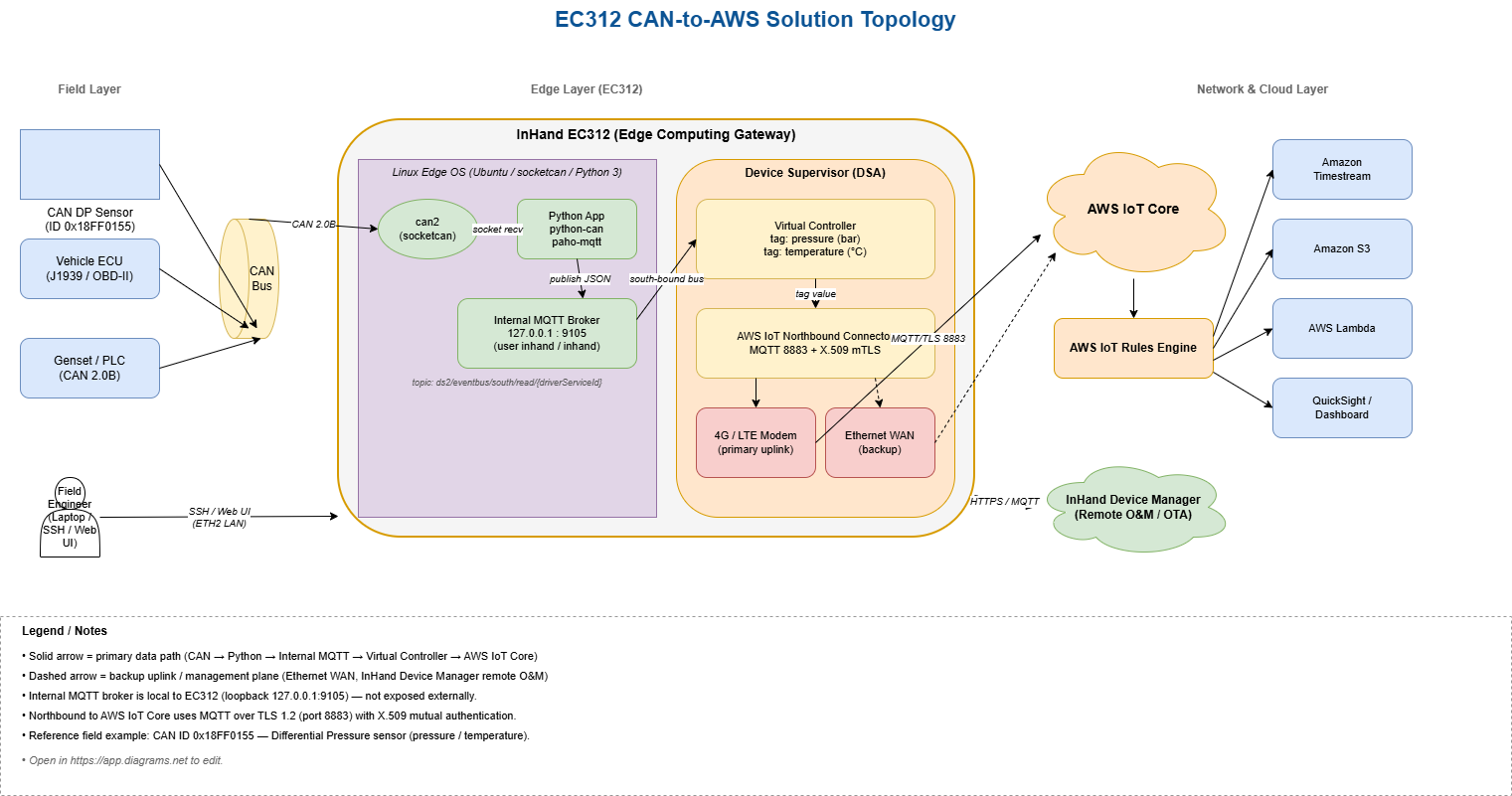
3.3 Data flow (south → north)
- Field CAN sensor broadcasts a CAN frame on the bus.
- EC312's
can2socket receives the frame; the Python app filters byarbitration_id. - The Python app decodes the payload (e.g. pressure / temperature) and converts to physical units.
- The Python app publishes a JSON payload to the internal MQTT broker of Device Supervisor on
ds2/eventbus/south/read/{driverServiceId}. - The Virtual Controller receives the measurement and stores it as a tag (e.g.
pressure). - DSA's AWS IoT north-bound publishes the tag value to the configured AWS IoT topic over TLS.
- AWS IoT Core forwards the message to subscribers / Rules Engine for storage and visualization.
4. Network & Connectivity Design
4.1 Uplink selection
| Option | Recommended for |
|---|---|
| 4G/LTE | Vehicles, mobile assets, remote sites — primary choice for this solution |
| Ethernet (WAN) | Fixed installations with wired internet — backup or alternative |
| Wi-Fi | Local commissioning, plant Wi-Fi |
| Dual SIM (model-dependent) | Mission-critical fleets needing carrier redundancy |
4.2 Why EC312
- Native CAN — built-in CAN interface (
can2used in this case), accessible from Linux viasocketcan. - Open Linux edge OS — root SSH,
apt, Python 3, fullpython-can/paho-mqttsupport. - Device Supervisor (DSA) — built-in industrial protocol & cloud connector framework (Modbus, OPC UA, MQTT, AWS IoT, Azure IoT…).
- Industrial design — DC 9–36 V wide voltage, wide temperature, vehicle-grade.
- Remote O&M — InHand Device Manager cloud for fleet-scale configuration and OTA.
5. Data Acquisition & Protocol
5.1 South-bound (field → edge)
- CAN 2.0A / 2.0B (this case: extended ID
0x18FF0155) - Modbus RTU / TCP, OPC UA, custom serial — supported via DSA drivers or custom Python apps
- Standard automotive / industrial dialects: J1939, OBD-II, NMEA 2000
5.2 North-bound (edge → cloud)
- AWS IoT Core (this case) — MQTT + X.509 mutual TLS
- Other supported clouds via DSA: Azure IoT Hub, Alibaba Cloud IoT, generic MQTT broker, HTTP REST
- Internal interface for custom apps: MQTT message bus at
127.0.0.1:9105(userinhand/inhand)
5.3 Sample decoded payload
6. Security
- TLS 1.2 with X.509 mutual authentication between EC312 and AWS IoT Core
- AWS IoT policy restricts the device to its own MQTT topics
- Local web management protected by username / password (default
adm/123456— must be changed) - SSH access restricted to the edge LAN port
- Configuration backup / restore via the gateway's
Services → Configuration Management - Remote upgrade and audit through InHand Device Manager
7. Solution Highlights
- CAN-native edge — direct kernel-level CAN socket, no extra USB adapter required.
- Python at the edge — full Linux + Python 3 +
python-can+paho-mqtt; customers can ship their own decoders. - Decoupled architecture — Python app ⇄ internal MQTT ⇄ Virtual Controller; the same pipeline works for any protocol the customer can parse in Python.
- One-click AWS — Device Supervisor ships an AWS IoT north-bound: just paste the endpoint + X.509 certs, no glue code.
- Fleet-ready — remote O&M via InHand Device Manager for hundreds or thousands of EC312s.
- Vehicle-grade — wide voltage, wide temperature, designed for in-vehicle and outdoor cabinets.
8. Bill of Materials (per site)
| # | Item | Notes |
|---|---|---|
| 1 | InHand EC312 Edge Computing Gateway | With CAN, 4G/LTE, Linux |
| 2 | SIM card | Carrier per region; APN as required |
| 3 | 4G antennas | Main (+ AUX where applicable) |
| 4 | Power supply | DC 9–36 V |
| 5 | CAN harness | DB9 or terminal wiring to CAN bus |
| 6 | AWS IoT Core account | Endpoint, Thing, X.509 certs, policy |