Smart Low-Voltage Power Distribution Networking Solution
I. Solution Overview
1.1 Project Background
An electrical enterprise focuses on the R&D and manufacturing of low-voltage power distribution equipment, providing customers with comprehensive smart low-voltage power distribution solutions. With the advancement of smart grids and digital transformation, the demand for intelligent and networked low-voltage power distribution systems is growing.
1.2 Construction Objectives
- Achieve intelligent management of low-voltage power distribution systems
- Real-time monitoring of power distribution equipment operational status
- Enhance safety and reliability of power distribution systems
- Reduce operation and maintenance costs, achieve remote monitoring
1.3 Applicable Scenarios
- Smart power distribution systems
- Low-voltage switchgear monitoring
- Unattended distribution rooms
- Smart building power distribution
II. Requirements Analysis
2.1 Current Equipment Status
- Equipment types: Smart circuit breakers, power distribution meters, residual current devices, etc.
- Communication interfaces: Ethernet, RS485, 4G
- Communication protocols: Modbus, MQTT, etc.
- Deployment environment: Distribution rooms, switchgear cabinets
- Scale: Distributed deployment
2.2 Core Requirements
- Real-time monitoring requirement: Real-time monitoring of electrical parameters such as voltage, current, and power
- Safety protection requirement: Leakage protection, overload protection, short-circuit protection
- Remote management requirement: Remote monitoring and control of power distribution equipment
- Fault early warning requirement: Abnormal alarms to detect potential problems in advance
- Energy management requirement: Electric energy metering and energy consumption analysis
III. Overall Architecture Design
This solution adopts an architecture of smart power distribution equipment + edge gateway + cloud platform to achieve intelligent management of low-voltage power distribution systems.
3.1 Four-Layer Architecture
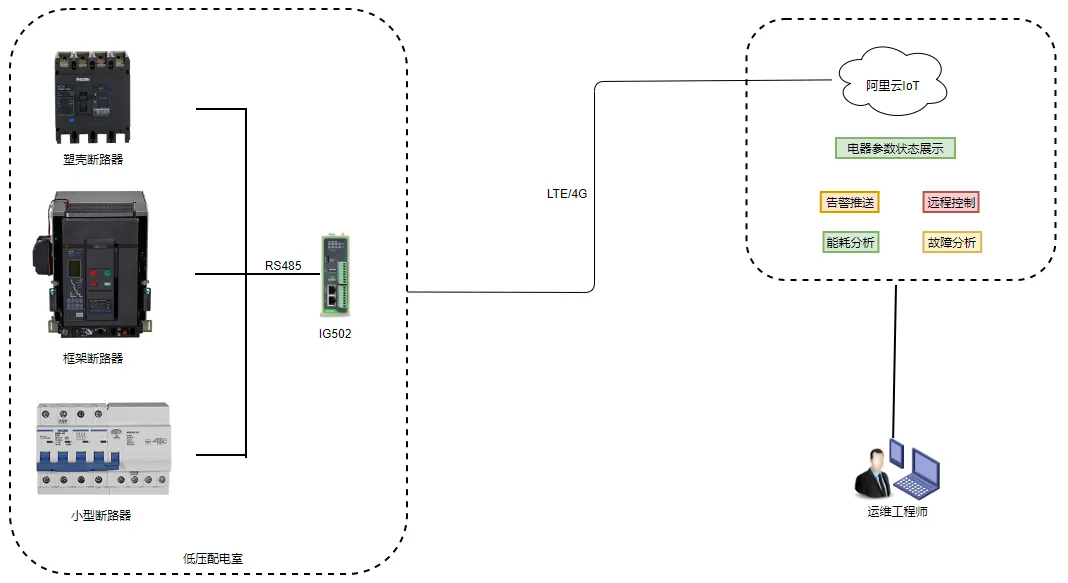
- Perception Layer: On-site equipment such as smart circuit breakers, power distribution meters, sensors
- Network Layer: Edge gateway, supporting multi-protocol access and data transmission
- Platform Layer: Power distribution management platform, data storage and analysis
- Application Layer: Monitoring large screen, mobile app, operation and maintenance management
3.2 Data Flow
On-site equipment → Edge gateway → Cloud platform → Application end
IV. Network and Access Solution
4.1 Networking Method Selection
Supports multiple access methods including wired Ethernet, 4G/5G wireless, etc.
4.2 Edge Gateway Selection Points
- Supports multiple industrial protocol access
- Supports common protocols for power distribution equipment such as Modbus
- Supports local data preprocessing
- Industrial-grade design, adaptable to distribution room environment
V. Protocol and Data Acquisition Solution
5.1 Supported Protocols
- Industrial protocols: Modbus RTU/TCP, DLT645
- IoT protocols: MQTT
- Network protocols: Ethernet, 4G/5G
5.2 Northbound Protocol Support
- Supports cloud platform access
- Supports standard API interfaces
VI. Solution Highlights Summary
-
Intelligent power distribution: Achieve intelligent management of low-voltage power distribution systems
-
Real-time monitoring: Real-time monitoring of electrical parameters and equipment status
-
Safety protection: Comprehensive leakage, overload, and short-circuit protection functions
-
Remote operation and maintenance: Remote monitoring and control, reducing maintenance costs
-
Energy analysis: Electric energy metering and energy consumption analysis to optimize electricity usage