AI & On-Site Decision-Making: Reinventing Construction Safety
As construction scales expand and operations grow more complex, construction site safety management now faces a practical challenge beyond just having systems or strict inspections:
With extended work areas, shifting phases, and heavy overlap of personnel and equipment, risks emerge scattered and dynamically, hard to capture centrally.
Traditional management relying on manual experience and fixed processes can no longer keep up with on-site dynamics.
01.Why does construction site safety management remain arduous despite significant investments?
Video surveillance is standard at large sites, covering most critical areas, but management effectiveness has not improved with “clearer visibility”.
The issue is not inadequate surveillance, but inherent lag in manual footage review, judgment and response—especially as risks grow more frequent and dynamic.
Systems record incidents but rarely intervene before risks escalate.
02.What Practical Barriers Must AI Overcome to Enter Construction Sites?
As AI visual analysis matures, some solutions upload on-site video to the cloud for intelligent identification.
This works in fixed, network-stable environments.
However, the actual conditions of construction sites often differ significantly from this premise.
Large sites have scattered areas and frequent phase shifts, making consistent network coverage hard to maintain.
Over-reliance on continuous data transmission harms identification timeliness and alert reliability, especially in remote sites, weakening system usability.
Stable on-site decision-making capabilities are essential for AI to contribute to real-time safety management.
03.What Is the Local AI Architecture Supporting On-Site Decision-Making?
AI at construction sites requires a stable on-site decision-making mechanism, not just connection to existing surveillance.
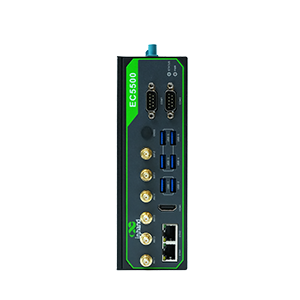
InHand Networks’ edge AI solution centers on a stable local AI mechanism, with the EC5550 Edge AI Computer as its core carrier.
On-site HD cameras capture footage, which is decoded, analyzed and judged locally by the EC5550, enabling near-instant risk identification without off-site transmission.
04.How Does On-Site AI Form a Closed Loop from Video Collection to Risk Judgment?
Reliable on-site AI relies on integrated computing power, stability and industrial adaptability, not just algorithms.
The EC5550’s core features ensure long-term AI operation:
- Local AI Computing Power: Equipped with a high-performance NVIDIA chip (100 TOPS), it enables real-time local analysis of multiple video streams for safety checks without cloud dependence.
- Multi-Channel Access: Supports simultaneous connection and parallel analysis of multiple HD cameras, ideal for dense monitoring areas.
- Industrial-Grade Stability: Resists dust, vibration and temperature fluctuations (-20℃ to 70℃), avoiding AI interruptions.
These invisible capabilities determine if AI is a demo or a long-term safety asset.
Risk Identification: How Does AI "Understand" Construction Risks On-Site?
Powered by the EC5550, AI continuously analyzes video streams to detect key risks: personnel presence, PPE compliance, dangerous area intrusion, and smoke/fire.
Based on continuous streams (not single frames), it reduces false/missed alarms. Stable long-term operation matters more than one-time identification.
Risk Identification: How Does AI "Understand" Construction Risks On-Site?
Powered by the EC5550, AI continuously analyzes video streams to detect key risks: personnel presence, PPE compliance, dangerous area intrusion, and smoke/fire.
Based on continuous streams (not single frames), it reduces false/missed alarms. Stable long-term operation matters more than one-time identification.
On-Site Response: What Happens When AI Identifies Risks?
Local risk detection triggers instant actions: management system alerts, on-site audio-visual warnings, and full event recording for later review.
The entire process is on-site, forming a true closed-loop safety chain without manual monitoring or cloud delays.
05.Why Is This Local AI Architecture Better Suited for Long-Term Construction Site Management?
On-site decision-making brings key engineering benefits:
- Network delay-free identification and timely responses;
- Reduced bandwidth demands (no continuous video upload);
- Enhanced data security via local processing.
Flexible industrial networking allows expanding camera coverage with project phases, ensuring sustained EC5550 performance.
The EC5550 evolves from a standalone device to a foundational, lifecycle-stable node for on-site AI safety management.
06.Only When AI Operates Stably On-Site Can Safety Management Truly Transform
Safety transformation lies in continuous risk detectability and intervenability, not more systems.
Stable on-site AI shifts safety management from post-event handling to proactive, continuous prevention.
Related Products: