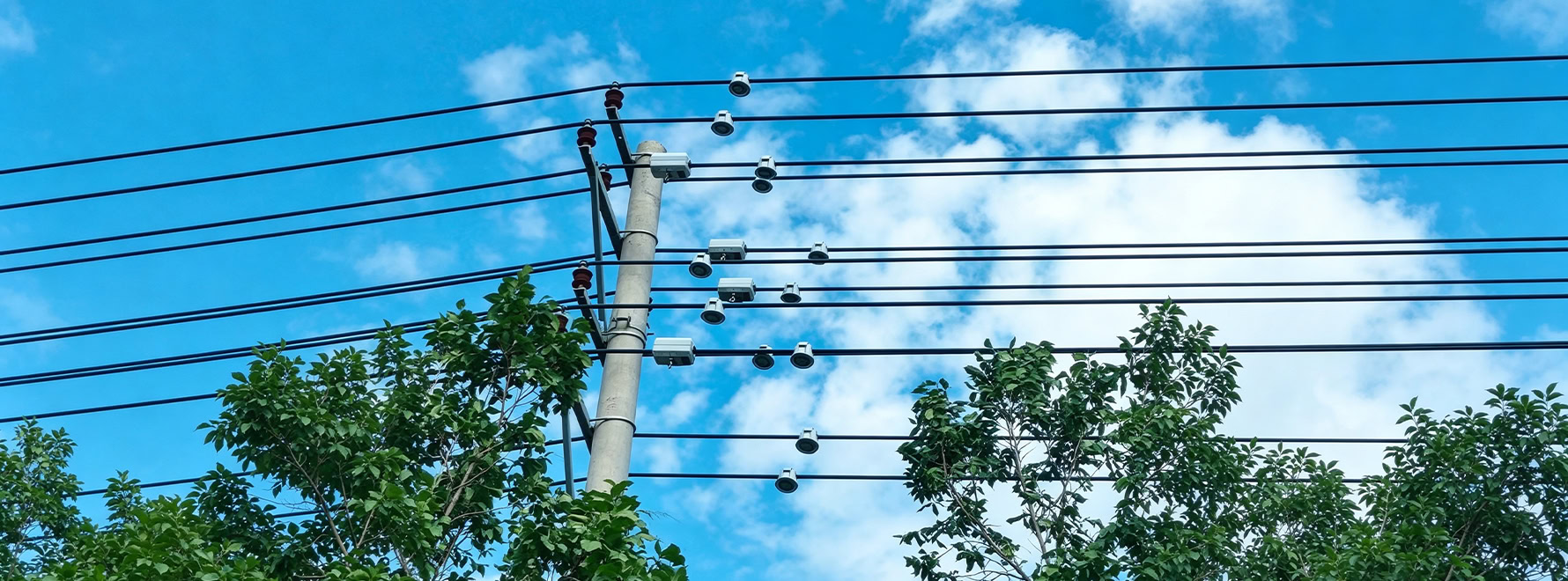
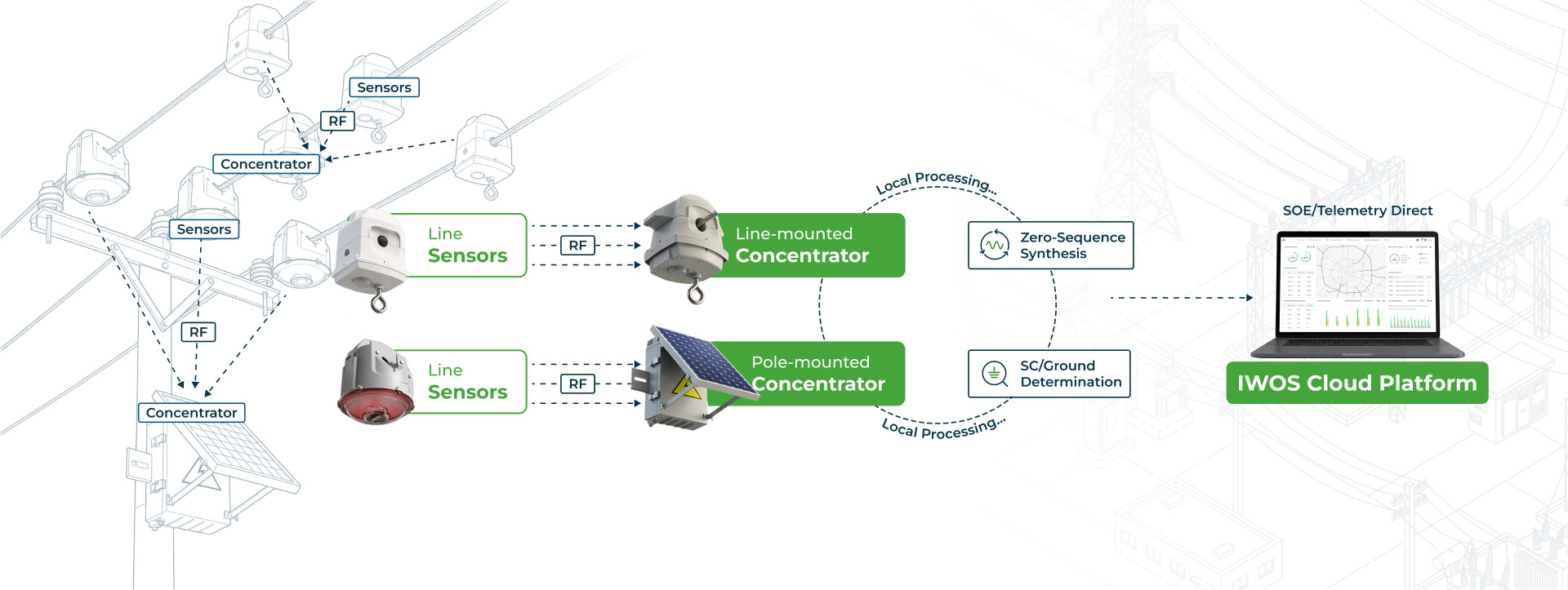
In this scenario, IWOS sensors communicate directly with SCADA via standard protocols. The concentrator locally synthesizes zero-sequence current and determines short-circuit/ground faults, sending SOE events and telemetry directly to SCADA without cloud AI. Featuring edge real-time analysis with minimal data links, it delivers rapid fault response for clear ground fault signatures, strict latency requirements, or data sovereignty. Unlike competitors using single-phase logic, IWOS's three-phase fusion and zero-sequence synthesis significantly improve ground fault accuracy and timeliness.
Background
Some utilities seek to simplify system hierarchy, accelerate fault response, reduce data flow steps, or keep operational data on-premises. They want IWOS devices to complete local fault determination and push results directly to their SCADA master stations. These customers typically have mature distribution automation teams capable of handling master station integration and business expansion, while leveraging IWOS edge hardware’s local computing power for faster, more direct fault awareness.
Customer Requirements
Direct Data Feed to Owned Master Station
Sensor monitoring data is sent directly to the customer's SCADA master station without third-party platform relay.
Full Control of Business Logic
Customers want to independently handle topology parsing, device management, and fault determination logic to meet deep customization needs with full unification into existing dispatch ecosystems.
Deep Integration with Existing Systems
Data formats, alarm rules, and interface styles remain consistent with the existing SCADA platform, requiring no adaptation for O&M personnel.
Solution
Unlike common industry single-phase short-circuit ground determination logic, IWOS concentrators capture ground fault characteristics more accurately through three-phase data fusion and zero-sequence synthesis. This enables highly reliable local real-time analysis for scenarios with clear ground signals. Determination results are sent directly to the customer’s SCADA master station as SOE events, with telemetry data uploaded periodically — minimal data links, zero delay.
In this mode, the SCADA master station primarily receives and displays SOE events and telemetry data, extending alarm, topology management, and remote O&M functions according to business needs. Customers can fully leverage their existing SCADA platform development capabilities to autonomously define data parsing rules, interface styles, and business processes — achieving deep unification with their dispatch ecosystem.
Benefits
Edge Real-Time Analysis, Zero Latency
The concentrator fuses three-phase data, synthesizes zero-sequence current, and determines faults locally — sending SOE events directly to SCADA. This eliminates cloud round-trips for millisecond-level fault alarms, meeting extreme real-time requirements.
Local Zero-Sequence, Superior to Rivals
Unlike competitors using single-phase short-circuit logic, IWOS concentrators fuse three-phase data and synthesize zero-sequence current locally — more accurately identifying ground faults with clear signatures while reducing false and missed alarms.
Minimal Data Link, Flat Architecture
Data flows directly from terminals to SCADA without cloud platform deployment or operation, reducing system layers and data transfer steps. Customers with in-house development capabilities can rapidly complete integration within their SCADA ecosystem.
Deep Fit with Own SCADA Ecosystem
All business logic and interface styles are fully controlled by the customer, seamlessly blending with existing dispatch systems to meet deep customization needs without requiring O&M staff to learn new platforms.
Related Solution
Power Distribution Overhead Line Monitoring System
AI-enabled intelligent overhead line monitoring and analytics solution


 Ask AI Anything