

Mo 68A
Single-Board Computer
Flagship open-source AI SBC with 8 TOPS for mid-to-high complexity edge inference, including robotics and industrial vision.
PHOTO


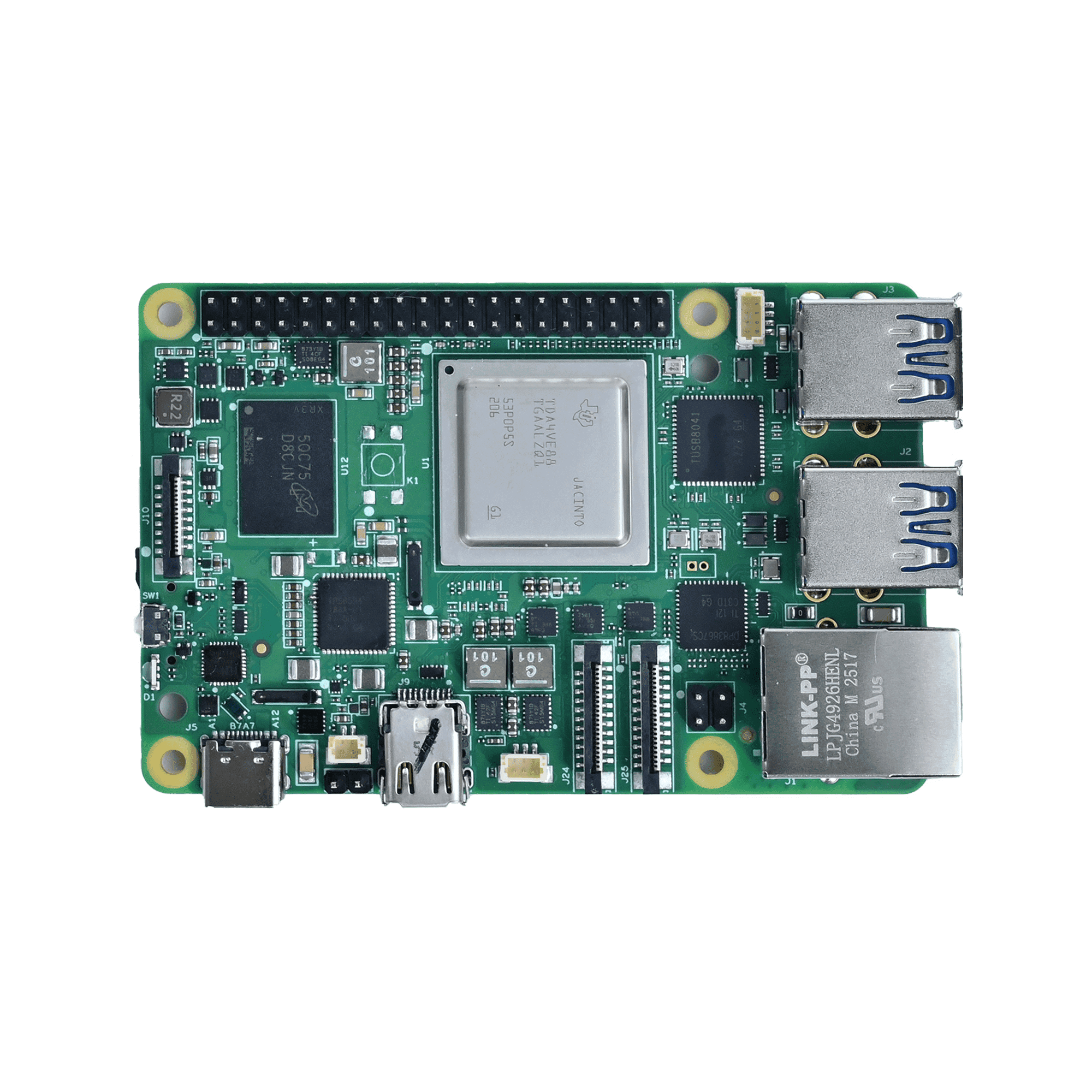
8 TOPS Flagship Open-Source AI SBC

High-Performance Processor
Powered by the Texas Instruments AM68A AI vision processor, featuring a Dual-core 64-bit Arm® Cortex®-A72 CPU up to 2.0 GHz

AI Acceleration
Equipped with C7x DSPs and Matrix Multiply Accelerators (MMAs), delivering up to 8 TOPS of deep learning performance

Rich Connectivity
High-speed PCIe 3.0 and USB 3.0, plus flexible multimedia I/O for cost-effective multi-camera and multi-display systems

Rapid Prototyping
A 40-pin expansion header enables solderless prototyping and broad compatibility with sensors, actuators, and connectivity accessories
-
Core Technical Specifications
AI Accelerator 2 × C7x DSP + Deep Learning Accelerator, 8 TOPSAI Runtime TI TIDL, supports TFLite / ONNXCPU 2 × Cortex-A72 @ 2.0 GHzDevelopment Python, C/C++, OpenCV, GStreamerDimensions (W × D × H) 85 × 56 mmInterface 1 × GbE, 4 × USB 3.0, PCIe 3.0, mini DP, MIPI DSI/CSI-2Operating Temperature 0 °C ~ +50 °COS Debian 13 (Embedded Linux)Power USB Type-C 5 V / 5 A DC; ≤ 25 WRAM LPDDR4 4 GB / 8 GB (default)安全 Secure Boot, TrustZone, OP-TEE, Hardware AES-256Vision VPAC, DMPAC, 4K@60fps H.265 / H.264 codec
-
Hardware Platform
AI Accelerator 2 × C7x DSP + Deep Learning Accelerator, 8 TOPSCPU TI AM68A, 2 × Cortex-A72 @ 2.0 GHzISP / Vision On-chip ISP + VPAC (RGB-IR, WDR, LDC)RAM LPDDR4 4 GB / 8 GB (default)
-
Interface
40-pin Connector GPIO / I²C / I²S / SPI / UART / PCM, HAT-compatibleAudio I²S via 40-pin connectorButton 1 × Reset buttonCamera up to 2 × 4-lane MIPI CSI-2Debug 1 × TTL UARTDisplay 1 × mini DP + up to 2 × 4-lane MIPI DSIEthernet 1 × Gigabit EthernetFan Connector 1 × 4-pin fan connector (5 V, PWM, GND, TACH)LED PWR, STATUSPCIe 1 × PCIe 3.0Storage Micro SDUSB 4 × USB 3.0 Type-A
-
Power
Power Consumption 25 W (MAX)Power input USB Type-C 5 V / 5 A DC
-
Mechanical
Cooling Active fan (optional)Dimensions (W × D × H) 85 × 56 mmHousing PCBRTC Support (battery backup)Weight 53 g
-
Environmental
Operating Temperature 0 °C ~ +50 °CStorage Temperature -20 °C ~ +70 °C
-
Operating System
Kernel Linux Kernel 6.12OS Debian 13 Trixie
-
AI & Vision
AI Runtime TI TIDL, supports TFLite / ONNXCamera Framework V4L2Display Framework DRM / KMSVision SDK TI EdgeAI SDK
-
Network Features
IP Application TCP / UDP, ICMP, DNS, DHCPIP Routing Static routing
-
安全
Crypto Accelerator Hardware AES-256OP-TEE 支持安全启动 支持TrustZone 支持
-
Development
Languages Python, C/C++Libraries OpenCV, GStreamer, NumPyOpen SDK Supports custom system build by customerPackage Manager apt (Debian)
-
System Management
Debug UART consoleFirmware Upgrade SD card flashRemote Access SSH
Standard package*
- Mo 68A AI Single Board Computer *1
- Optional accessories
- Power Supply *1
- Wi-Fi天线*1
- RTC Battery *1
- TTL Debug Serial Cable *1
- Fan *1
- 以太网线 *1
- 32GB SD Card *1
- Micro HDMI to HDMI (MO 62A) *1
- Mini DP to DP (MO 68A) *1
* Standard package contents vary by standard order codes.
Contact us directly to learn more about our packaging options.
DeviceLive
物联网设备管理平台
Device management, remote monitoring, edge app management, and remote maintenance to help industrial enterprises build intelligent edge networks.
Frequently Asked Questions
What does the MO-68A offer?
The MO-68A is an 8-TOPS AI single-board computer for on-device vision inference at the edge, built on the TI AM68A SoC (TDA4VE / J721S2 family). Key specs:
| — | — |
| Compute | 2× Cortex-A72 @ 2.0 GHz + 2× C7x DSP + 8-TOPS Deep Learning Accelerator |
| Vision pipeline | On-chip ISP + VPAC (RGB-IR, WDR, LDC) + DMPAC (depth and motion); up to 2× 4-lane MIPI CSI-2 |
| RAM | LPDDR4, 4 GB / 8 GB (default) SKUs ( MO-68A-4G/-8G ) |
| OS | Armbian (Debian-based) |
| 连接性 | 1× Gigabit Ethernet |
| Other I/O | 4× USB 3.0 Type-A, 1× PCIe 3.0, 1× mini DisplayPort (or up to 2× MIPI DSI), 40-pin HAT-compatible header, micro SD |
| 安全 | Secure Boot, ARM TrustZone, OP-TEE, hardware AES-256 |
| Power / size | USB Type-C 5 V/5 A (25 W max), 85 × 56 mm, 53 g — active fan required |
The 85 × 56 mm board and 40-pin HAT-compatible layout are mechanically compatible with standard SBC ecosystems. Typical applications: AI vision boxes, intelligent cameras, edge AI inference terminals, smart manufacturing, smart city, smart energy, smart healthcare, public utilities. The MO-68A is a developer-oriented SBC managed via SSH and standard Debian/Armbian tooling — it does not run InHand IEOS or DeviceLive.
How do I flash and boot the MO-68A for the first time?
- Flash the SD card — download the MO68A Armbian image from the InHand website. Use Armbian Imager (the recommended flash tool — *not* balenaEtcher) to write the image to a ≥16 GB Class 10 / UHS-I micro SD card. Select Use Custom Image, choose the storage carefully, then Erase & Flash.
- Connect peripherals in order — fan first (4-pin PWM at J7, required for thermal management), then SD card (J23), then optionally a mini DisplayPort monitor (J9) and USB keyboard/mouse for desktop use, then RJ45 Ethernet (J1).
- Apply power last — USB-C 5 V/5 A at J5. The status LED (D1) lights red immediately, then turns solid green when the OS is running. Normal boot ≈ 30–45 s; the first boot adds 1–2 minutes while the root filesystem expands to fill the SD card, after which the board auto-reboots once.
- First login — default credentials
root/1234. Armbian then runs a one-time initialization wizard for locale, timezone, and creating a regular user account.
For headless setup, the board uses DHCP on eth0 by default; SSH in with the user account created in the wizard. A 3-pin TTL UART debug header is also provided at J6 (115200 baud, 8N1) — 3.3 V logic only; a 5 V adapter will damage the board.
> Display note: The mini DisplayPort output requires a monitor with native DP input. Passive Mini DP-to-HDMI adapters do not work — use an active adapter or a DP-native monitor.
How do I run AI models on the MO-68A?
The 8-TOPS Deep Learning Accelerator and 2× C7x DSPs execute models through the TI Deep Learning (TIDL) runtime, which accepts TFLite ( .tflite ) and ONNX ( .onnx ) models. The on-chip ISP/VPAC handles RAW→RGB conversion, WDR, and lens correction; the DMPAC (depth and motion accelerator) adds depth-perception and motion-estimation pre-processing for stereo or multi-camera vision. Pre- and post-processing in Python or C/C++ commonly use OpenCV and GStreamer. The TI EdgeAI SDK and Linux frameworks (V4L2 for camera, DRM/KMS for display) are available on the supplied Armbian image.
At 8 TOPS — 4× the MO-62A — the MO-68A is suited to higher-throughput on-device inference: stereo depth, multi-camera scene understanding, larger object-detection models, OCR at higher frame rates, and combined vision + motion analytics.
How does the MO-68A compare to the MO-62A?
| MO-62A | MO-68A | |
| — | — | — |
| OS | Debian Linux | Armbian (Debian-based) |
| SoC | TI AM62A74 | TI AM68A (TDA4VE / J721S2 family) |
| CPU | 4× Cortex-A53 @ 1.4 GHz | 2× Cortex-A72 @ 2.0 GHz |
| AI compute | 2 TOPS (1× C7x DSP + DLA) | 8 TOPS (2× C7x DSP + DLA + DMPAC) |
| RAM | 2 / 4 (default) / 8 GB | 4 / 8 GB (default) |
| USB | 4× USB 2.0 | 4× USB 3.0 |
| PCIe | — | 1× PCIe 3.0 |
| Display | micro HDMI | mini DisplayPort |
| MIPI | 1× CSI-2 | up to 2× CSI-2 / DSI (switchable) |
| Cooling | active fan optional | active fan required |
| Weight | 47 g | 53 g |
Pick the MO-62A for lower-cost 2-TOPS edge AI on a fanless or fan-optional board with passive cooling and HDMI display out. Pick the MO-68A when the application needs 4× the AI compute (stereo depth, multi-camera, larger models), faster USB 3.0 / PCIe 3.0 expansion, dual MIPI ports, or DMPAC-accelerated depth/motion processing.
—